
At the 5th Transition Design Conference 2026, held in Mexico City from July 8 to 11, 2026, Kimoto Hiromi, a doctoral student in our laboratory, gave a research presentation on how sustainability transitions might be enabled in the semiconductor domain, and on the part university education can play in bringing them about.
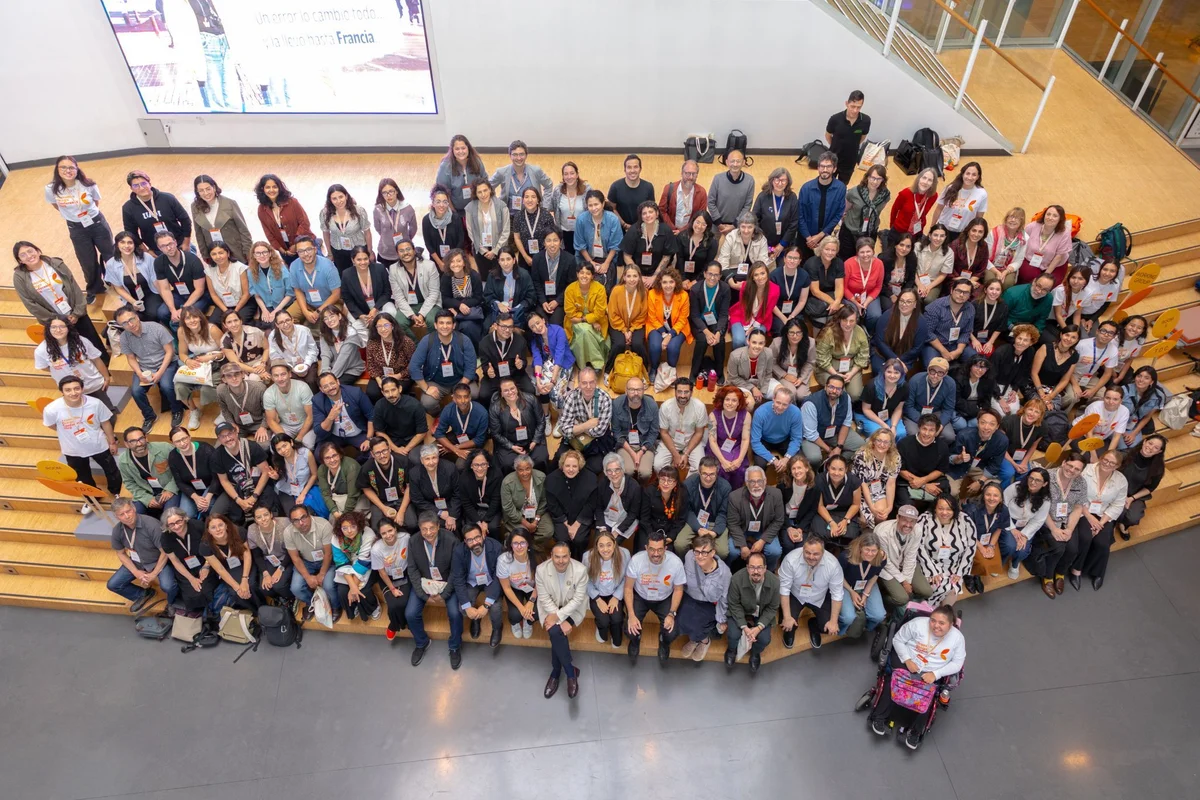
Transition Design Conference 2026
The conference was organized by Tecnológico de Monterrey (Mexico), the University of Palermo (Argentina), and the Transition Design Institute at Carnegie Mellon University (USA), and held at Tecnológico de Monterrey's Mexico City campus under the theme “Weaving Regenerative Futures.” Researchers and practitioners working on sustainability transitions and systems change gathered from across the world, with keynotes delivered by Terry Irwin, İdil Gaziulusoy, and Anand Pandian.
The presentation: a practice–education cycle in the semiconductor domain
Semiconductor innovation has long been organized around international technology roadmaps. Attention gathers around technical metrics such as miniaturization and performance, while the infrastructure for cross-sector deliberation on a normative question — what kinds of sustainable futures semiconductors should enable, and through which pathways — remains thin. Education has the same shape. It centers on the specialized competencies each segment of the supply chain demands, and offers few settings in which students learn to articulate a preferable future and translate it into an implementable socio-technical concept.
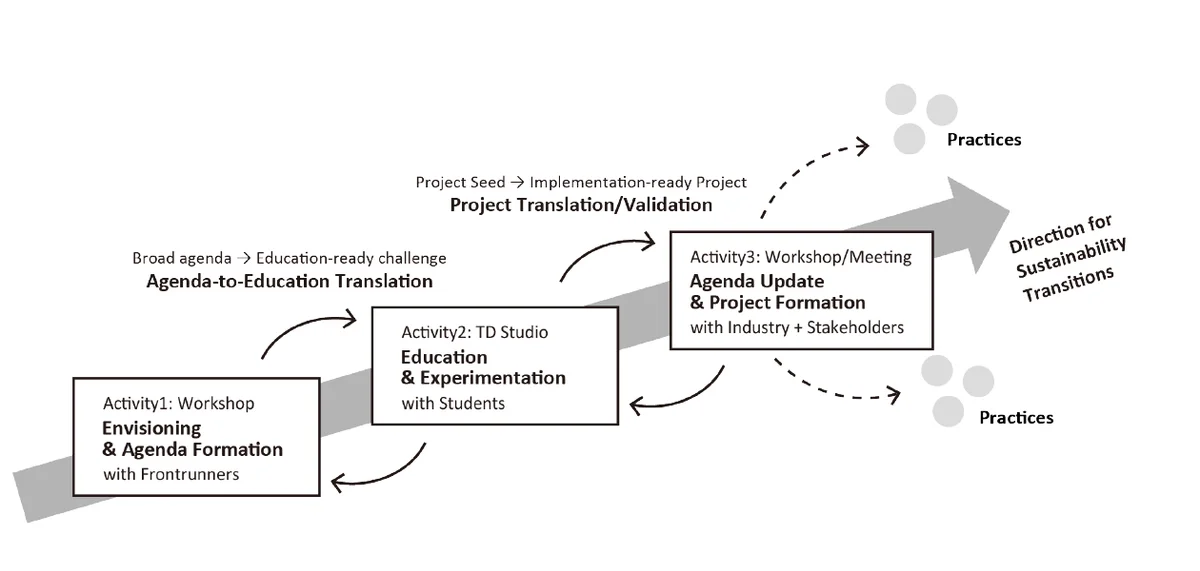
The TPEC (Transition Practice–Education Cycle) proposed in the paper is a process framework built to bridge that gap. Grounded in Transition Design and Transition Management, it iteratively links three activities: (1) a workshop with frontrunners that forms transition agendas, (2) a university project-based learning program, the Transition Design Studio, that carries them into education and experimentation, and (3) a forum that returns the outputs to industry and place-based stakeholders and updates the agenda. Its point is to use education as a site for prototyping interventions toward transitions.
With Institute of Science Tokyo acting as a transition intermediary, an initial cycle ran from January 2025 to February 2026. The workshop in Activity 1 drew 36 frontrunners from the semiconductor sector and from six domains: agriculture, logistics, healthcare, drones, smart cities, and entertainment. The TD Studio in Activity 2 ran for 16 sessions across a semester. Ten master's and doctoral students worked in the Miyagi district of Aoba Ward, Sendai City (roughly 900 households, an aging rate of 45.8 %), taking “building sustainable living infrastructure in depopulating rural regions” as their design challenge and drawing a single line from systemic analysis through future visioning and PSS ideation to SoC design requirements.
Looking back on the implementation through Research through Design, what the initial design lacked becomes visible at the joints between activities. Agenda-to-Education Translation reconstructs a broad agenda into a design challenge that holds up as a semester of teaching. Project Translation and Validation lifts the project seeds students generate toward implementable projects by working through business viability, funding structures, implementing agents, and technology selection. Since semiconductor development and manufacturing demand high initial investment and sufficient production volume, educational outputs never become investable business opportunities on their own. The revised TPEC writes both into the framework as explicit design acts, rather than leaving them as informal coordination.
Working backward from a desirable socio-technical future to semiconductor design requirements, and judging whether semiconductors should be used in that context at all: the presentation names this cluster of abilities Transition-oriented Semiconductor Capability, and offers it as a candidate educational goal for enabling technology sectors.
Bibliographic information
Kimoto, H., Fujisaki, M., Inoue, K., Kamitsubo, N., Takagi, S., Saito, K., & Ohashi, T. (2026). Enabling Sustainability Transitions in the Semiconductor Domain: Designing a Transition Practice–Education Cycle. Transition Design Conference 2026, Mexico City. doi:10.5281/zenodo.21056064
Closing
Semiconductors are a foundational technology working their way into every domain of society. For what future, and which problems on the ground get translated into design? The TPEC is an attempt to place that question inside education itself. We will keep designing the infrastructure that connects practice and education, building it as we go.