
PETER — AI Monitoring for Grazing Cattle
PETER remotely monitors grazing cattle location, movement, feeding, rumination, and rest using edge AI and LPWA communication. We aim to reduce farmer workload while improving animal welfare, driving the transition of the livestock industry from both technological and social perspectives.
Background
Japan's livestock sector faces serious challenges, including an aging workforce and a shortage of successors. Grazing is often seen as a promising approach because it can reduce labor demands while also supporting animal welfare. At the same time, it is not easy to keep track of physical condition changes or signs of estrus across large pasture areas. Many existing sensor systems have been designed for large-scale farms overseas, and they do not always fit the conditions of small, family-run grazing farms in Japan.
The PETER System
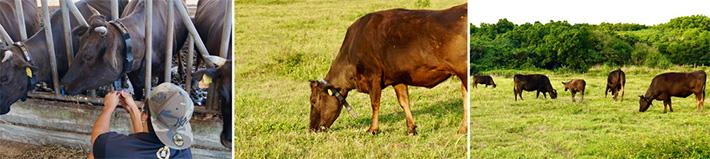
PETER has been developed through a collaborative project led by Science Tokyo (formerly Tokyo Tech), together with Shinshu University, ISID, Farmnote, Technopro Design, and Sony Group. A lightweight collar-mounted device collects acceleration and GPS data from cattle, and edge AI uses a neural network to classify behaviors in real time. These behaviors include grazing, ruminating, resting, and walking. Data transmission is supported by Sony's LPWA technology, ELTRES™, which enables long-range communication with low power consumption. Field testing began in 2021 at Sakura Farm on Kuroshima Island in Okinawa. The project has also explored the possible use of the system in asset-based lending (ABL).
Smart Livestock Technology Adoption
Alongside the technical development, this project also examines how smart livestock technologies are adopted in Japan's small-farm context. Interviews with 10 experts across the cattle, swine, and poultry sectors suggest that adoption is not a single decision made at one moment. Rather, it is a gradual and iterative process shaped by farm-level conditions, sectoral practices, and the broader social environment. The findings also indicate that close personal relationships within small farming communities, as well as differences in attitudes between younger and older generations, play an important role in shaping adoption decisions.
Transition Design Perspective
PETER is concerned not only with developing sensing and communication technologies, but also with understanding how such technologies are accepted and used in practice. The project looks at livestock production as part of a broader system that includes farming practices, consumer preferences, distribution structures, animal welfare-related institutions, and financial arrangements. From this perspective, the project asks what role technology can play in changing that system over time. These questions are examined through the lens of transition design and the Multi-level Perspective, together with fieldwork grounded in real production settings.